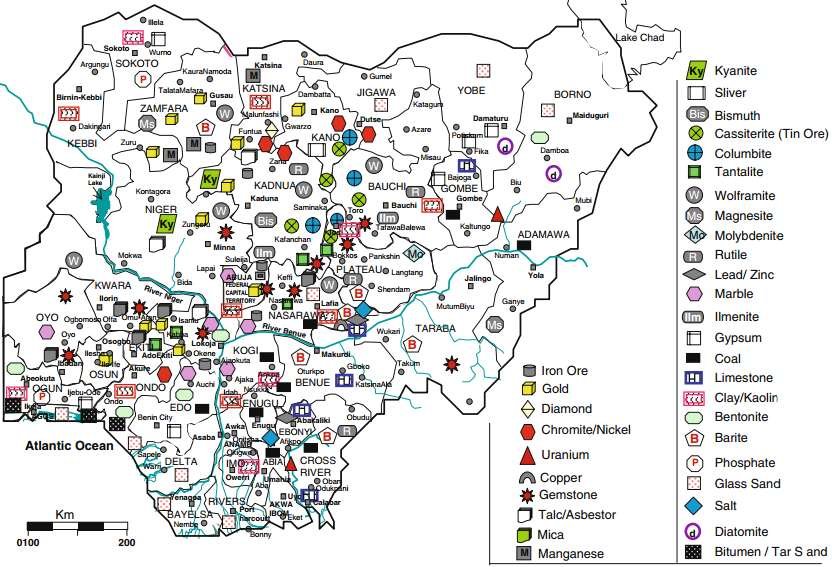
Nigeria is one of Africa’s most richly endowed countries in terms of solid natural (mineral) resources, with commercially viable deposits spread across all six geopolitical zones. These resources form the geological foundation for industrial development, construction, energy transition, agriculture, and export trade. Understanding their geographic distribution is critical for policy planning, investment decisions, community development, and sustainable exploitation. The distribution of solid minerals in Nigeria is not random; it follows well-defined geological belts and formations that reflect the country’s complex tectonic and sedimentary history.
Geological Context of Nigeria’s Mineral Endowment
Nigeria’s geology is broadly divided into three major formations:
- The Precambrian Basement Complex, covering much of the north and southwest, rich in metallic and industrial minerals;
- Younger Granite Complexes, particularly in central Nigeria, associated with tin, columbite, and related minerals; and
- Sedimentary Basins, mainly in the south and parts of the north, hosting limestone, gypsum, coal, and other industrial minerals.
This geological diversity explains why Nigeria hosts both metallic and non-metallic minerals in commercially relevant quantities across different regions.
North-Central Zone (Nigeria’s Solid Minerals Heartland)
The North-Central zone is often regarded as the epicenter of Nigeria’s solid minerals sector due to the concentration and diversity of deposits.
- Plateau State is historically known for tin and columbite, with mining activities dating back to the early 20th century.
- Nasarawa State hosts significant deposits of barite, limestone, salt, lead, zinc, and gemstones, making it one of the most mineral-diverse states in Nigeria.
- Kogi State is rich in iron ore, coal, limestone, marble, and feldspar, positioning it as a strategic hub for steel, cement, and construction industries.
- Benue State contains deposits of limestone, barite, lead, and zinc, while
- Niger State hosts gold, talc, granite, and iron ore.
This zone plays a central role in supplying raw materials for Nigeria’s cement, steel, and construction sectors and remains critical for future industrial expansion.
North-West Zone
The North-West zone is primarily associated with metallic minerals, especially gold.
- Zamfara State is widely known for gold deposits, which have attracted artisanal and small-scale mining activities.
- Kebbi State hosts gold, limestone, and phosphate, while
- Kaduna State contains gold, marble, and clay.
- Katsina State is known for kaolin, silica sand, and phosphate.
While the region holds significant potential, much of its mining activity remains artisanal, highlighting the need for formalization, improved safety standards, and structured market access.
North-East Zone
The North-East zone is notable for industrial and energy-related minerals.
- Gombe State hosts gypsum, limestone, and coal, essential for cement and construction industries.
- Bauchi State contains deposits of lead, zinc, coal, and tin, while
- Borno State is known for limestone, gypsum, and clay.
- Taraba State is particularly rich in barite, gold, lead, zinc, and gemstones, making it one of the most promising states in the zone.
- Adamawa State hosts kaolin, gypsum, and granite.
These minerals support construction, manufacturing, and energy-related industries and present strong opportunities for regional industrial clusters.
South-West Zone
The South-West zone is dominated by industrial minerals that support Nigeria’s construction and manufacturing base.
- Ogun State is Nigeria’s leading producer of limestone, hosting some of the country’s largest cement plants.
- Ondo State has deposits of bitumen, limestone, and glass sand, with bitumen considered one of Nigeria’s most strategic untapped resources.
- Ekiti and Oyo States contain granite, kaolin, feldspar, and marble, supporting quarrying and ceramics industries.
- Osun State is a major hub for gold, with both artisanal and mechanized mining activities.
This zone plays a critical role in supplying materials for infrastructure development and industrial production.
South-East Zone
The South-East is historically associated with coal and industrial minerals.
- Enugu State is famous for its coal deposits, which once powered Nigeria’s railway and power sectors.
- Ebonyi State hosts lead, zinc, limestone, and salt, while
- Abia and Imo States contain clay, limestone, and glass sand.
- Anambra State is rich in coal, clay, and lignite.
The region holds renewed relevance as Nigeria explores alternative energy sources and industrial raw materials.
South-South Zone
The South-South zone, widely known for oil and gas, also possesses important solid minerals.
- Cross River State hosts limestone, barite, lead, zinc, and granite, supporting cement and quarry industries.
- Edo State contains limestone, marble, clay, and silica sand.
- Akwa Ibom State has limestone, salt, and glass sand, while
- Delta and Rivers States contain silica sand and clay.
These resources support construction, manufacturing, and glass production industries within the region.
Strategic Importance of Nigeria’s Mineral Distribution
The widespread distribution of solid minerals across Nigeria presents a unique opportunity for balanced regional development. Rather than concentrating industrial growth in a few locations, Nigeria can develop regional mineral-based industrial clusters, reduce logistics costs, and promote local employment. However, realizing this potential requires coordinated policies, infrastructure investment, responsible mining practices, and strong institutions such as professional associations to support miners and marketers.
Conclusion
Nigeria’s solid natural resources are geographically diverse and economically strategic. From metallic minerals in the north to industrial minerals in the south, every region of the country contributes to the national mineral base. Properly harnessed, these resources can drive industrialization, support economic diversification, create millions of jobs, and strengthen Nigeria’s position in global mineral value chains. Structured organizations like ASMMMON play a critical role in ensuring that these resources are developed responsibly, transparently, and for the benefit of present and future generations.